
This International Women’s Day and Women’s History Month, we want to celebrate some of the fascinating women associated with Samuel Johnson and the city of Lichfield by sharing the objects connected to them in the Birthplace collection.
Sarah Johnson
Sarah Ford, mother of Samuel Johnson, was born on 6 April 1669. She married Michael Johnson in 1706; Michael ran his bookselling business on the ground floor of their house (now the Samuel Johnson Birthplace Museum!). The couple had two sons, Samuel and Nathaniel.
Following her husband’s death in 1731, Sarah continued the bookshop. In the collection, we have a very special letter to Sarah from her son, Nathaniel. This letter is an important document; not only does it tell us more about Nathaniel (who we know very little about) and the relationship between him and his mother, but it also gives us a glimpse into Sarah Johnson, the businesswoman. The letter is addressed to ‘Mrs. Johnson, Bookseller in Lichfield’, and in it, Nathaniel discusses the business and acting on Sarah’s behalf to recoup accounts owed.

Letter from Nathaiel Johnson to Sarah Johnson (2001.71.57)
Elizabeth ‘Tetty’ Johnson
Elizabeth Jervis was born on 4 February 1689 and married her first husband, Harry Porter, on her twenty-sixth birthday. The couple had a daughter and two sons. After Harry’s death, Elizabeth married Samuel Johnson on 9 July 1735. Her sons disowned her because of her second marriage, but her daughter, Lucy, remained close to her mother and stepfather for the rest of their lives.
Elizabeth—who was given the nickname ‘Tetty’ by her new husband—funded Johnson’s school at Edial Hall, where he taught Latin and Greek to a small group. Eventually, they moved to London, where Johnson worked as a writer. Sadly, Tetty did not live long enough to see the publication of Johnson’s A Dictionary of the English Language; she died in 1752.
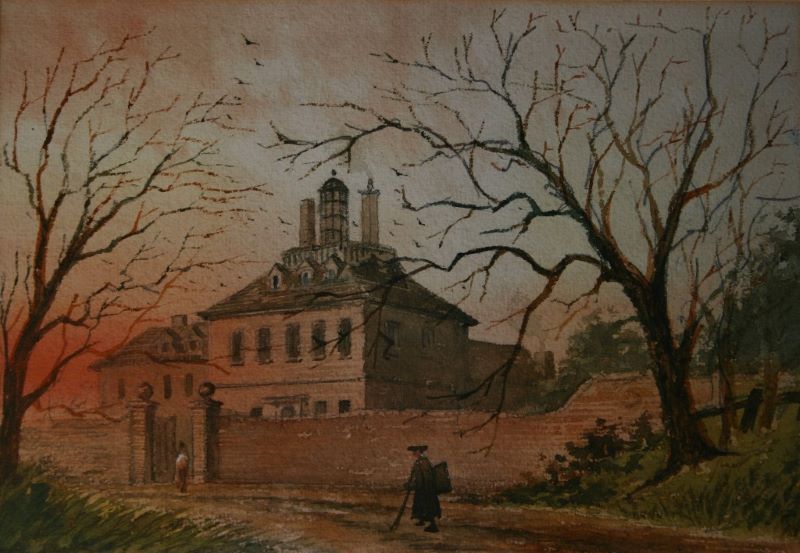
Tetty funded Johnson’s school at Edial Hall. Watercolour of Edial House, Nr Lichfield by Paul Braddon; 1890 (2001.179)
We have no surviving documents written by Tetty, but we have several objects associated with her in our collection. Her portrait, which is displayed on the first floor of the Museum, is painted after an original by Maria Verelst; it depicts a dignified and handsome woman—a far cry (at that point in her life) from the ‘painted poppet’ that David Garrick described.

Portrait of Elizabeth Johnson. It is a modern copy of a portrait by John Sanders, after the original by Maria Verelst (2001.177)
The Birthplace has a pair of Tetty’s scissors that were donated to the Museum in 1909, along with a knife and fork once belonging to her husband. These items give us a rare glimpse into the Johnsons’ domestic life—one can imagine the couple in front of a roaring fire, Tetty using her scissors while sewing, and Johnson using his cutlery as he enjoys some supper.
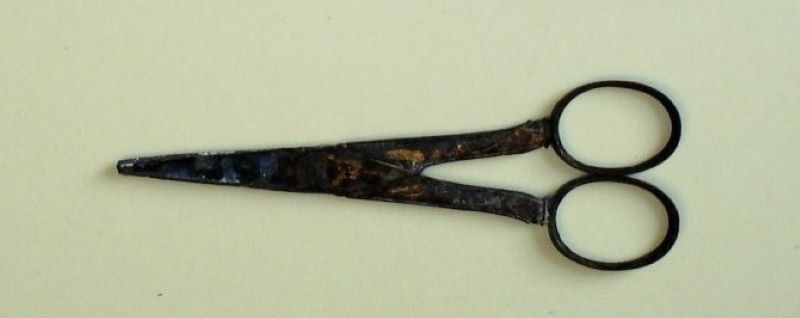
Elizabeth Johnson’s scissors, the remnants of a gold pattern are just visible on the surface (2001.334.3)
Tetty’s saucer—an early 18th-century piece of Chinese export—is on display on the second floor of the museum. After his wife’s death, Johnson would eat his breakfast roll from the saucer each morning—which he affectionately called ‘Tetty.’ Displayed next to the saucer is Tetty’s gold wedding ring. After the death of his spouse, Johnson kept the ring in his possession for the rest of his life.
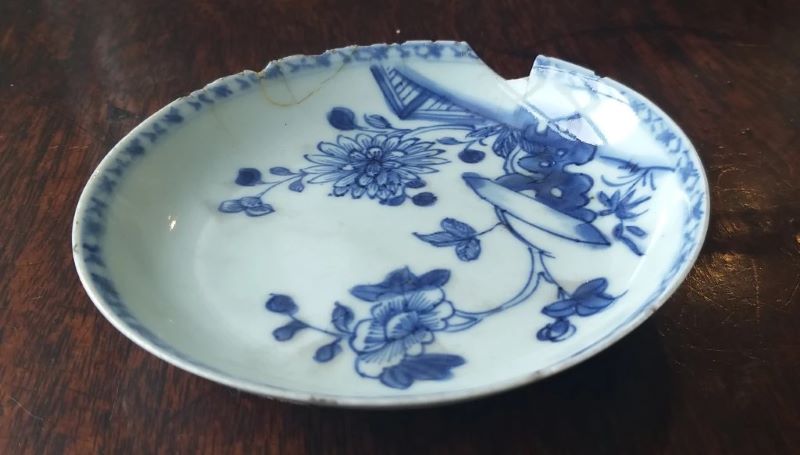
‘Tetty’, Johnson’s breakfast saucer (2001.63)

Tetty’s wedding ring (2001.3301)
Lucy Porter
Lucy Porter was born in 1715 and was Tetty’s daughter from her first marriage. Unlike her brothers, Lucy remained close to her mother and Samuel Johnson. When Johnson and Tetty left for London, Lucy stayed at the Birthplace to help run the bookshop with Sarah Johnson—whom she called ‘Granny’—and maidservant, Catherine Chambers.
When Tetty died, Johnson and Lucy maintained a good relationship; Johnson sent gifts to his daughter-in-law, and the two regularly corresponded. Their close bond is demonstrated in a letter from our collection, dated 12 July 1768; Johnson jokingly chides his daughter-in-law, ‘Do not you owe me a letter?’ He tells Lucy about his plans to visit the seaside and asks Lucy to ‘Let me know how you do, and how you go on, and whom you have with you. For I would willingly hear that you are well and happy.’
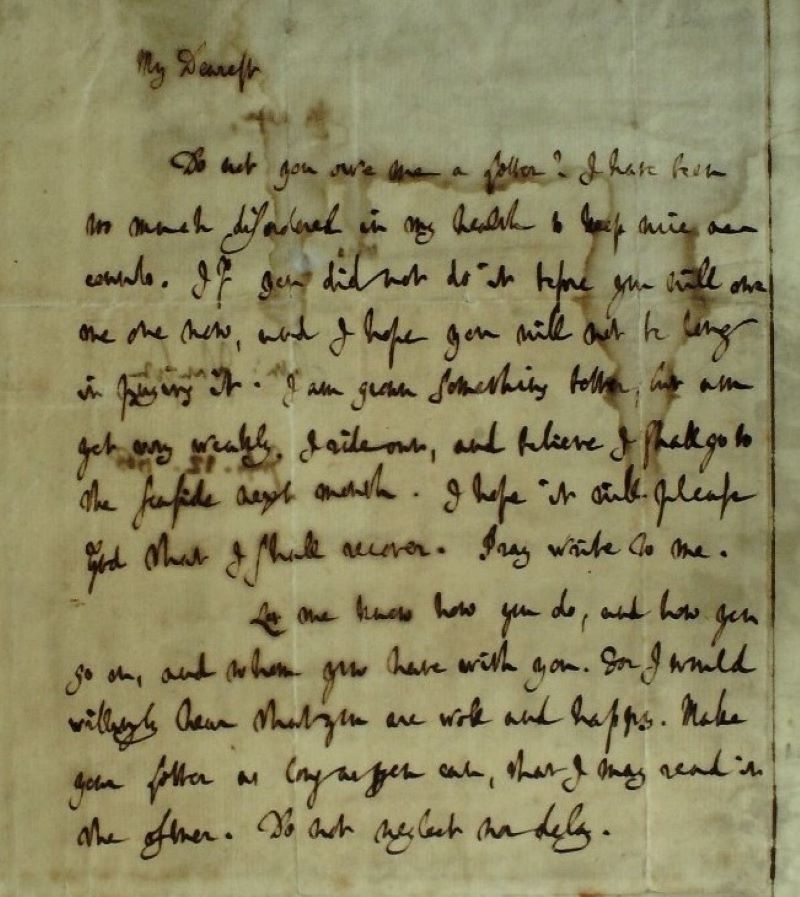
Letter to Lucy Porter from Samuel Johnson (2001.71.55)
We have two portraits of Lucy at the Birthplace—in very different styles! The first is a vivid oil painting of her as a child, displayed opposite her mother’s portrait. The other is a silhouette portrait—a popular style at the time—and depicts an older Lucy’s side profile in silhouette.

Lucy Porter as a child by Maria Verelst, around 1723 – 1726 (T141)

Silhouette of Lucy Porter, right profile (2001.113)
Catherine ‘Kitty’ Chambers
As a teenager, Catherine ‘Kitty’ Chambers went to live with the Johnson family and became Sarah Johnson’s maidservant. When Michael Johnson died, Sarah continued the family bookselling business. In her advancing years, she was assisted by Kitty and Lucy Porter. Kitty went on to become a bookseller, also working from the Birthplace.
Kitty was more than just a maidservant; she was held in high regard by the Johnson family. She witnessed and signed an indenture of a mortgage on the Birthplace for Sarah and Samuel Johnson in 1757. The document, now in our collection, is one of the only known surviving samples of Kitty’s handwriting.

Indenture of a mortgage of the Birthplace, witnessed and signed by Catherine Chambers (2001.70.1.1)
Following the death of his mother, Johnson wrote to Lucy in 1759 and asked her to tell Kitty that she, ‘. . . may carry on the trade [bookselling] for her self, keeping her own stock apart . . . I fancy Kitty can do nothing better . . . let her know I have the highest value for her’. In another letter, which is in the collection, written in March 1759, Johnson wrote to Lucy and wished Kitty success in her trade as a bookseller!

Letter written to Lucy Porter from Samuel Johnson, in which he wishes Kitty success in her trade as a bookseller (2001.82)
Hester Piozzi
Hester Lynch Thrale Piozzi (née Salusbury) was born in 1741; she married wealthy brewer Henry Thrale in 1763. Hester’s letters, poetry, travel accounts, diaries, and marginalia provide us with an excellent source for life in the later Georgian and Regency periods. Known to Samuel Johnson as Hester Thrale for the duration of their friendship, Piozzi was his close friend and confidante; the two regularly corresponded.
The Thrales had a house at Streatham, and Hester wrote that the residence afforded her ‘quiet and comfort’, compared to living in London town, which she described as being an ‘odious dungeon.’ Johnson was a regular visitor to the Streatham home, and the view depicted below in pen and ink is one he would have known after extensive improvements to the property in 1771.

The Late Mr Thrale’s (House) Streatham by Peter Richard Hoare (2015.8.2)
In the Birthplace collection, we have a portrait miniature of Hester, painted in 1811. It depicts her in mourning attire following the death of her second husband, Gabriele Mario Piozzi, in 1809. Gabriele Piozzi was a singing master and composer who had been a tutor to the Thrale children. Several of Hester’s children and friends (including Johnson) objected to Hester’s new relationship, but the couple married in 1784.

Portrait miniature of Hester Lynch Piozzi, 1811, by an unknown artist (2001.139)
Hester Piozzi’s Anecdotes of the late Samuel Johnson LLD during the last twenty years of his life were published in 1786, and an edition of their correspondence was published in 1788. The first edition of Anecdotes was so popular that it was said to have sold out on the first day, with four more editions appearing by May. The Birthplace Museum has a special copy of this book among a small collection of books annotated by Hester herself. Her additional notes add extra details to her texts, and she points out items of particular interest with an illustration of a little hand.
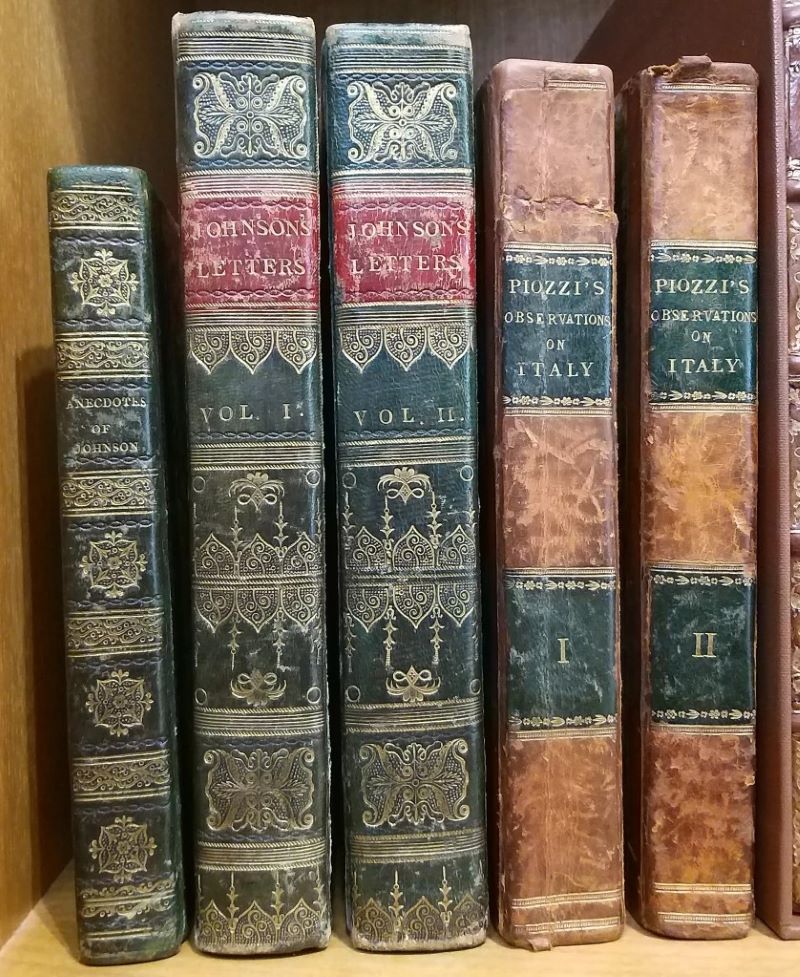
Anecdotes of the late Samuel Johnson LL.D during the last twenty years of his life by Hester Piozzi (2001.55.251)
Hester had an ongoing association with Lichfield and Johnson’s circle after his death, as demonstrated in this letter, written in Hester’s hand during a visit to Lichfield. The Reverend Henry White invited her to visit; however, she makes excuses for herself, Mr. Piozzi, and her daughter Cecilia, as they are already engaged to see Peter Garrick, brother of David Garrick. She instead suggests they meet at their lodgings at the Swan Inn.
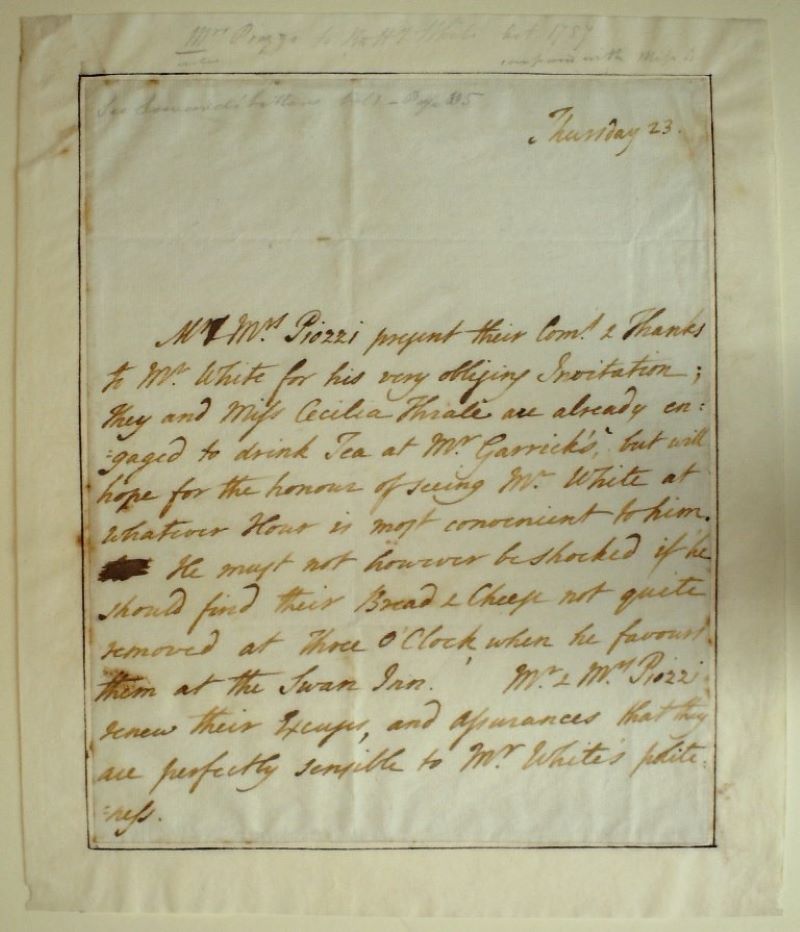
Letter written 23 August 1787, by Hester Piozzi to the Reverend Henry White (2001.71.28)
Sophia Thrale
In 2023, the Samuel Johnson Birthplace Museum announced the acquisition of the only known surviving correspondence between Samuel Johnson and Sophia Thrale—the daughter of Hester Lynch Thrale (later Piozzi). Although the letter had been previously documented, its location was unknown. After being found in a cupboard at a country home, it was sold at auction in September 2023.
The letter, addressed to twelve-year-old Sophia, was penned by Johnson in 1783; he encourages her to continue her studies, especially mathematics. He tells her of the enjoyment and benefits of such knowledge and expresses great confidence in her abilities by recommending a book containing a very complex calculation for a child.
The correspondence is a significant example of women’s education being encouraged by a man living in the Georgian era. It demonstrates Johnson’s enlightened views on the importance of women’s education and is an example of Johnson’s closeness to the Thrale family.
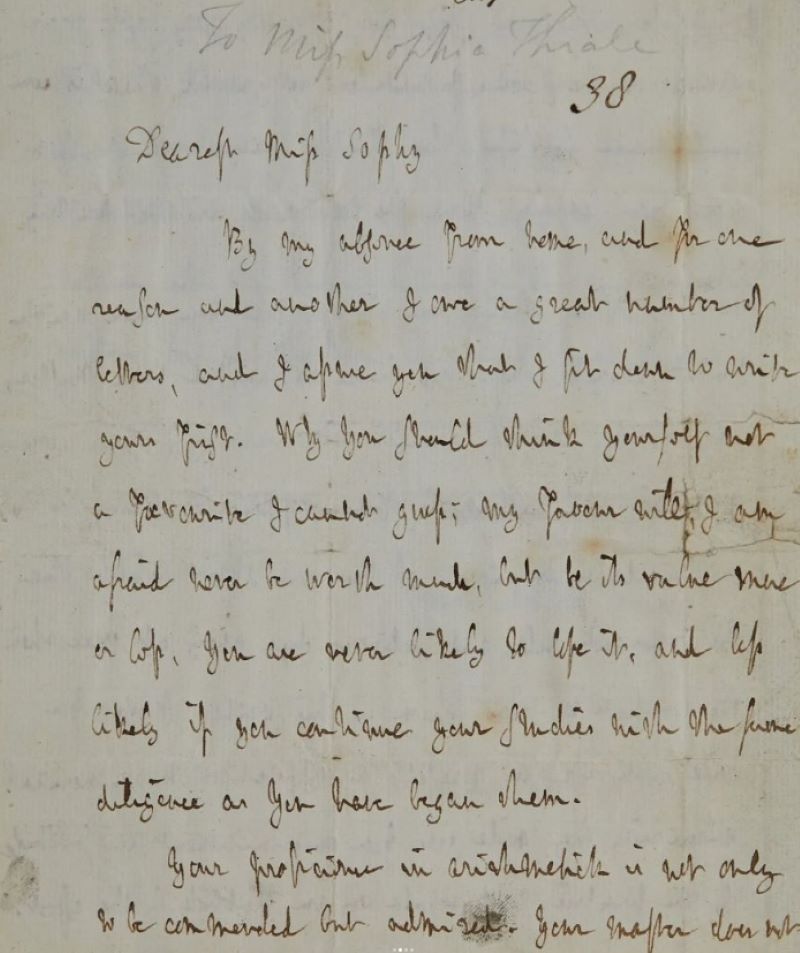
Letter written by Samuel Johnson to Sophia Thrale, 1783 (2023.1). Purchased with the assistance of Friends of the National Libraries, The Johnson Society, Phil Jones, and Lichfield City Council.
Anna Seward
Anna Seward was born in Derbyshire in 1742; she spent most of her life in Lichfield and is fondly known as the ‘Swan of Lichfield’. Seward is renowned for her poetry and correspondence; she also submitted work to the Gentleman’s Magazine, and she wrote a biography of fellow Lichfield resident Erasmus Darwin.

Portrait of Anna Seward. Engraved by A. Cardon after an original picture painted in 1762, by Kettle. Published by Mess Constable and Co, March 1811 (2000.226)
Seward began writing poetry at a young age; her most popular work was Louisa, a poetical novel. We have examples of Seward’s poetry in the collection, such as her epic poem Telemachus, an unpublished manuscript written around 1797, paraphrased from François Fénelon’s Télémaque.
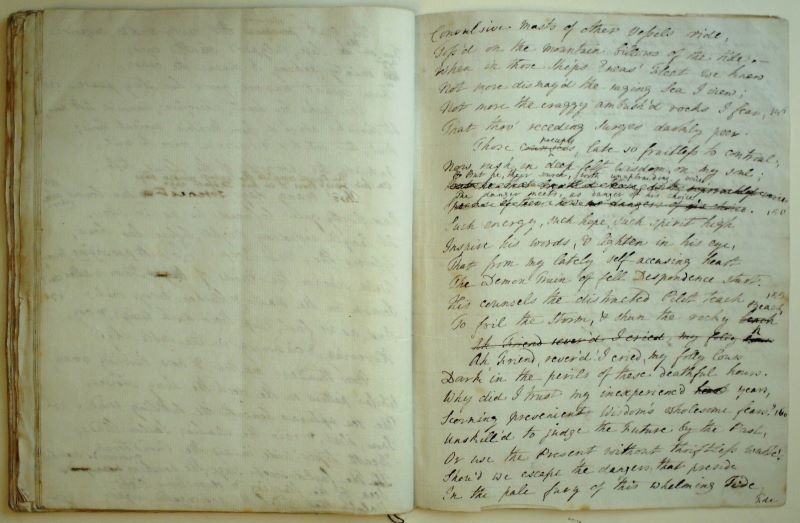
Telemachus, Anna Seward’s epic poem (2001.98)
Seward was acquainted with a wide circle of well-known figures from her day; amongst our collection, we have letters written to Anna from recognisable names, such as Josiah Wedgwood, James Boswell, and Sarah Siddons. The appearance of these names demonstrates how respected Seward and her work were by her peers – quite an achievement in a time dominated by men! In her letter to Anna, the celebrated actress Sarah Siddons thanks Anna for sending her some poetry. Siddons writes that she sends her ‘…grateful acknowledgments for the honor you have done by sending me your beautiful poems.’
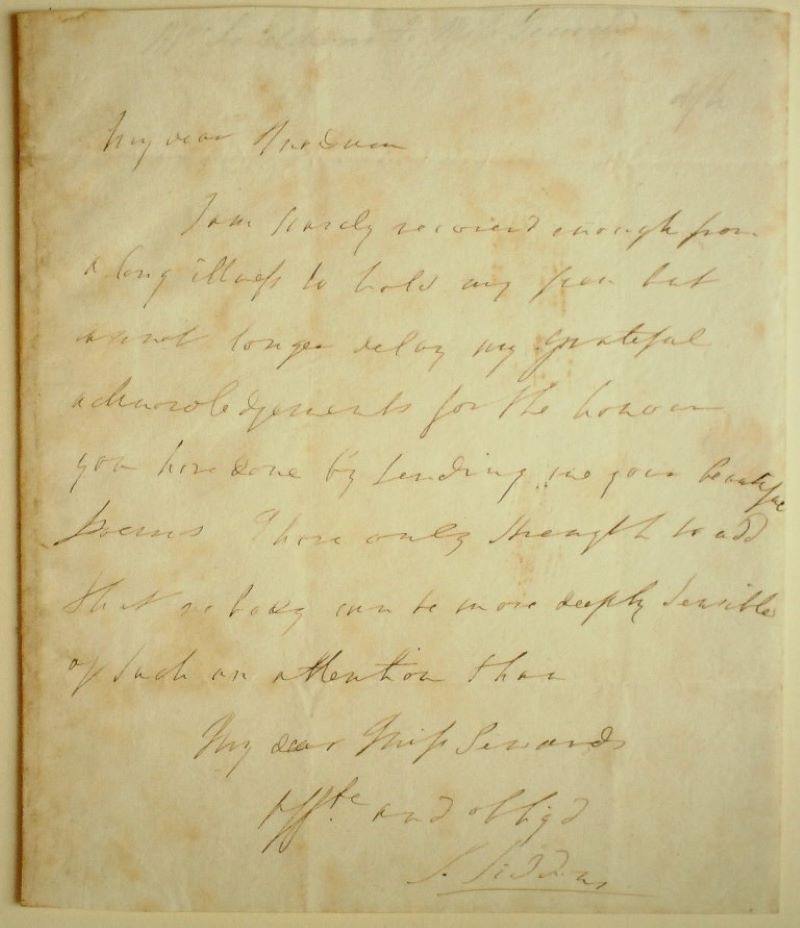
Letter from Sarah Siddons to Anna Seward (2001.71.44)
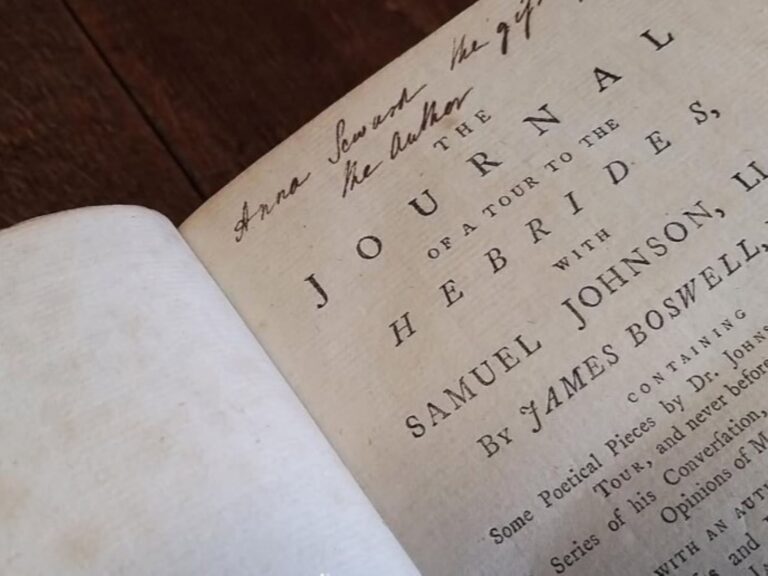
Anna Seward was a keen critic, a brilliant example of which is in her annotations in The Journal of a Tour to the Hebrides with Samuel Johnson, LL.D. gifted to Seward by the author of the book, James Boswell. Anna objects to Johnson’s comment, reported by Boswell in the text, that Garrick had not made Shakespeare better known. She points to the fact that, in other company, Johnson had praised Garrick, saying that he “seized the very soul of Shakespeare” and “extended its glory over the world” – I wonder what Johnson would have had to say about that!
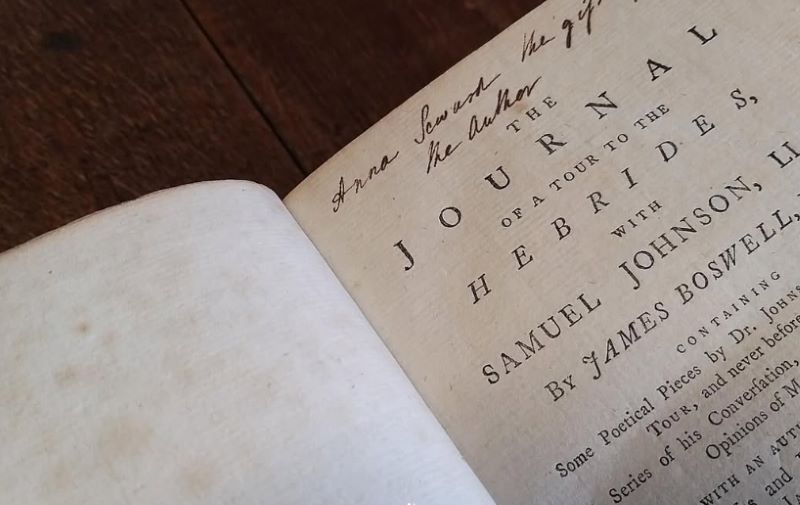
Copy of The Journal of a Tour to the Hebrides, with Samuel Johson, LL.D. by James Boswell; annotated by Anna Seward (2001.1138)