
Samuel Johnson’s mother, Sarah Ford, was born on 6 April 1669. In 1706 she married Michael Johnson, who ran his bookselling business on the ground floor of their house in Lichfield — the building now known as the Samuel Johnson Birthplace Museum. Together they had two sons, Samuel and Nathaniel.
But who was Sarah, beyond being a wife to Michael Johnson and a mother to their sons? For International Women’s Month, we want to explore who Sarah was as a person by looking at the limited evidence that survives.
Like many of the women who feature in Samuel Johnson’s life, his mother remains somewhat of a mystery. We catch glimpses of her personality through recorded anecdotes. Sam recalled a domestic story of his parents: ‘My father considered tea as very expensive and discouraged my mother from keeping company with the neighbours and from paying visits or receiving them. She lived to say, many years after, that if the time were to pass again, she would not comply with such unsocial injunctions.’ This memory suggests a woman who valued sociability and who later reflected critically on the restrictions placed upon her.

Another anecdote reveals her courage and resourcefulness. In 1712, Sarah took her young son to London to be touched by Queen Anne as a “cure” for his scrofula (tuberculous lymphadenitis — an infection which typically causes swollen lymph nodes, fevers, decreased appetite, and weight loss). Travelling alone, she feared being robbed during the journey and cleverly sewed their money into her skirts to protect it from highwaymen and other thieves.
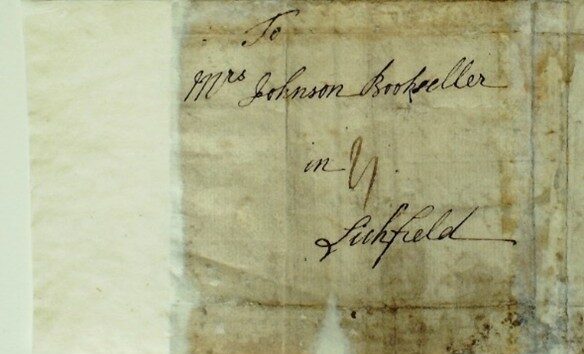
When Michael Johnson died in 1731, Sarah took over the family business and was recognised as a bookseller in her own right. In the Birthplace collection, there is a letter addressed to ‘Mrs. Johnson, Bookseller in Lichfield’, written by her son Nathaniel. In it, he discusses the business and refers to acting on his mother’s behalf to recoup outstanding accounts. The letter not only sheds light on Nathaniel — about whom we know very little — but also offers a glimpse of Sarah as a working bookseller who delegated tasks while continuing to manage the shop herself.

Female booksellers were very much part of the book trade in Georgian Britain. Although their history is less visible than that of their male counterparts, women ran successful businesses as booksellers, printers, stationers and bookbinders. An advertisement in the Derby Mercury (06 August 1740) lists ‘Mrs Johnson at Litchfield’ among the booksellers selling A New and Compendious System of Optics, in Three Parts by Benjamin Martin, printed for J. Hodges in London. She appears alongside fellow Midlands-based female booksellers: Mrs Unett at Wolverhampton and Mrs Heathcote in Uttoxeter.
In the Birthplace collection we have another fine example of Sarah as a businesswoman, which survives in a prayer book bought from her in 1732. It is inscribed in ink by the customer, Mrs Priscilla Hebbe: “bought from Mrs. Johnson 16 June 1732. Pd 01s.00d. Mrs Hebbe”. Hebbe was servant and housekeeper to Johnson’s godfather, Richard Wakefield, who by his will of 15 August 1733 left Priscilla the choice between a lump sum of £100 and an annuity of £10 [1]. The book was later transferred to Richard Wakefield, and the surviving inscription gives us an idea of Sarah’s pricing in 1732. Mrs Hebbe clearly thought it worth recording that the book was bought from ‘Mrs Johnson’, long before Sarah’s son found fame with his Dictionary of the English Language and other works.

Sarah also appears as a subscriber to The Harleian Miscellany; Or, A Collection of Scarce, Curious, and Entertaining Pamphlets and Tracts…, where she is listed as ‘Mrs. Sarah Johnson, of Litchfield’. A listed subscriber helped to finance a book in advance of it being printed — an early form of what we might now call “crowdfunding”. Published in 1744, The Harleian Miscellany was a collection drawn from the library of the Earl of Oxford and Earl Mortimer, collated and edited by Samuel Johnson and William Oldys between 1744 and 1753 on behalf of the publisher Thomas Osborne. Sarah’s subscription to the book is a touching reminder of the bond she shared with her son.
Sarah also had a close bond with Lucy Porter, who stayed with Sarah and helped to run the bookshop when her mother Elizabeth ‘Tetty’ Johnson and stepfather Samuel left for London; Lucy affectionately called Sarah ‘Granny’. Catherine ‘Kitty’ Chambers, Sarah’s maidservant, also seems to have had a close relationship with her mistress and helped run the bookshop as well as caring for Sarah during her final illness. After the death of Sarah Johnson in 1759, Kitty Chambers remained in the house and entered the book trade for herself, with help from Lucy Porter until Kitty’s death in 1767.

Although much about Sarah Johnson remains elusive, these fragments allow us to see more than simply the wife of a bookseller or the mother of a famous son. They reveal a determined and resourceful woman: a strong matriarch in a family mostly remembered for its male members, a recognised businesswoman in her own right, and someone clearly loved and respected by those around her.
Resources:
[1] Reades of Blackwood Hill and Dr. Johnson’s Ancestry, p. 227