

This month we welcome John Winterton, Johnson Society of Lichfield council member and editor of ‘Transactions’, who gives insight into a little known American literary connection to Lichfield.
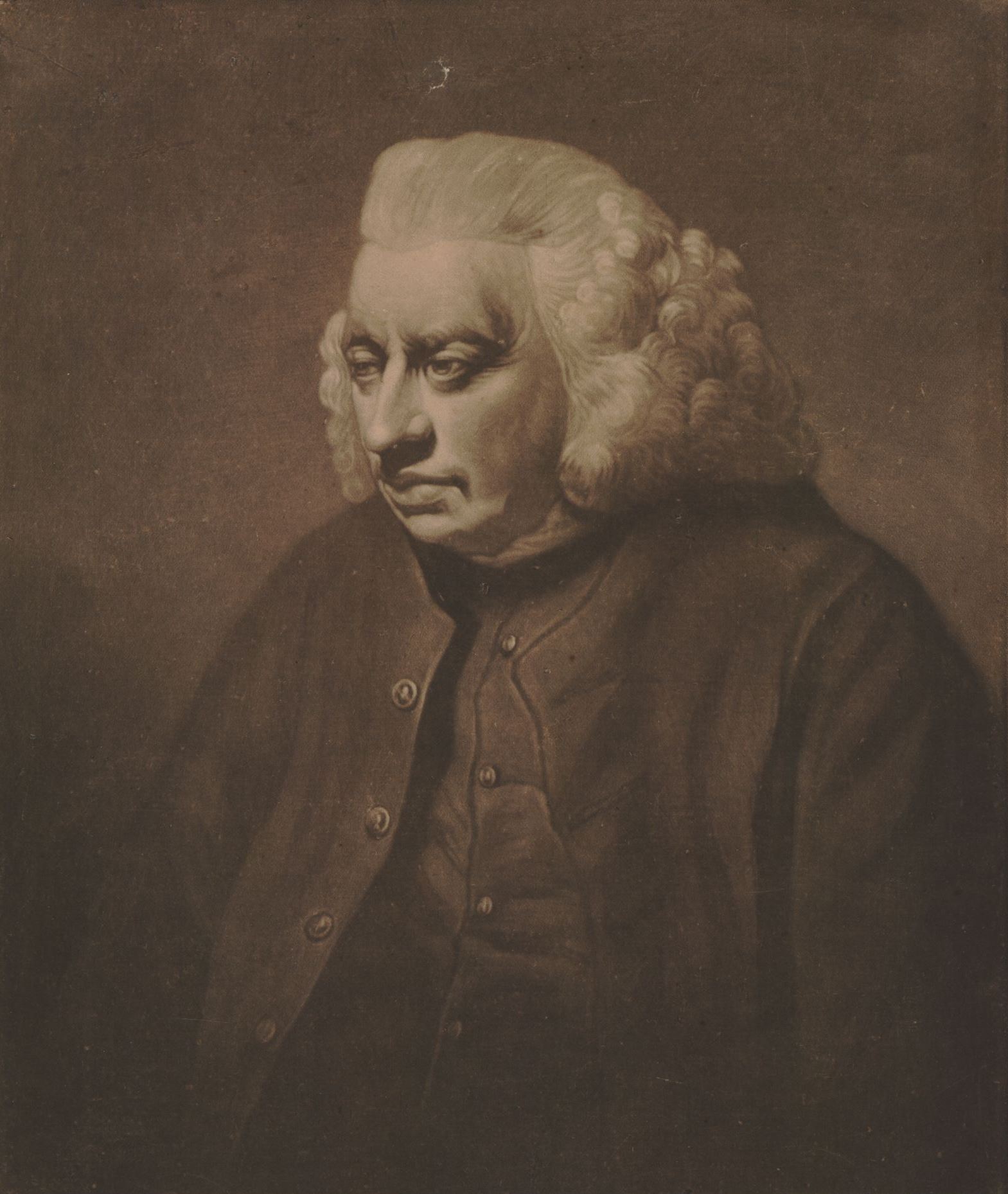
Samuel Johnson became a national figure in Britain during his own lifetime; however, his fame also swiftly spread to places as far distant as Pennsylvania, where one of his most fervent early admirers was the poet Elizabeth Graeme Fergusson.
Elizabeth Graeme was born in 1737. Her father was a well-to-do medical man, her mother the stepdaughter of a deputy governor of Pennsylvania. At the family home, Graeme Park near Philadelphia, Elizabeth had access to her father’s library, and was well educated, becoming proficient not only in Greek and Latin, but in French and Italian too – so much so, in fact, that one later admirer described her as ‘the most learned woman in America’.
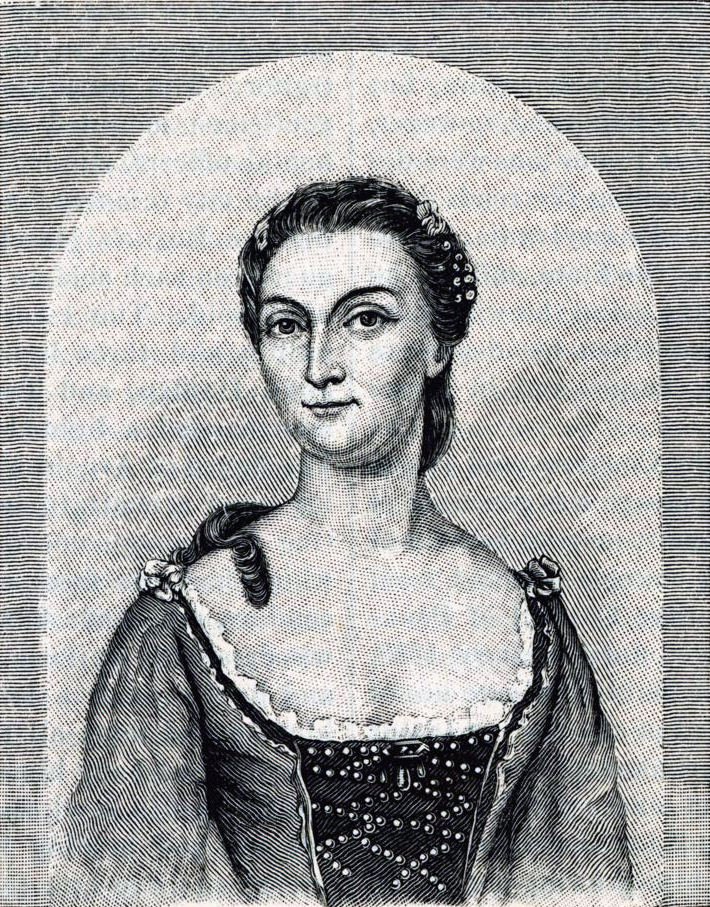
Elizabeth became engaged to Benjamin Franklin’s son William; however, he subsequently broke off the engagement, which left Elizabeth in a state of depression. To help revive her spirits, her parents sent her on a tour of Britain during 1764–5; here she was presented to George III, and also met the novelist Laurence Sterne – but, sadly, not (as far as we know) Johnson. The conclusion of Elizabeth’s tour was saddened by the death of her mother; shortly after her return home she also lost her last surviving sibling, Ann Graeme Stedman. As diversion in the midst of her woes, she immersed herself in literary composition and translation.
In 1772 Elizabeth married Henry Hugh Fergusson, with whom she settled at Graeme Park. During the American Revolution Henry sided with the British; he eventually fled to England, abandoning Elizabeth. Because of his pro-British activities, in 1778 Graeme Park was confiscated; although Elizabeth was able to reclaim it in 1781, she was later forced to sell the property when it proved uneconomic to run. Her last years were cheered by the companionship of her close friend and relative Betsy Stedman; Elizabeth died in 1801.
Quite when Elizabeth first became aware of Johnson is unclear; she was, however, certainly familiar with his writings in his lifetime. Following the confiscation of Graeme Park, an inventory and valuation of its contents was made on 17 September 1778 with a view to its sale. The inventory included Elizabeth’s much-treasured library, in which were ‘4 volumes of the Rambler’ (valued at one pound ten shillings).
Evidence of her enthusiasm for another of Johnson’s writings appears in a letter that she wrote on 21 April 1786 to her close friend Dr Benjamin Rush, in which she praises The Lives of the Poets as ‘a work which ex[c]ites wonder, when one recollects the compiler was on the verge of fourscore’; in this letter she also describes Johnson as ‘a miracle’ and ‘a wonder of a Man’. Elizabeth’s most sustained expression of her admiration for Johnson, however, is found in a work which she wrote in 1787: ‘A Tribute to British and American Genius: in two Odes on the Litchfield Willow’.
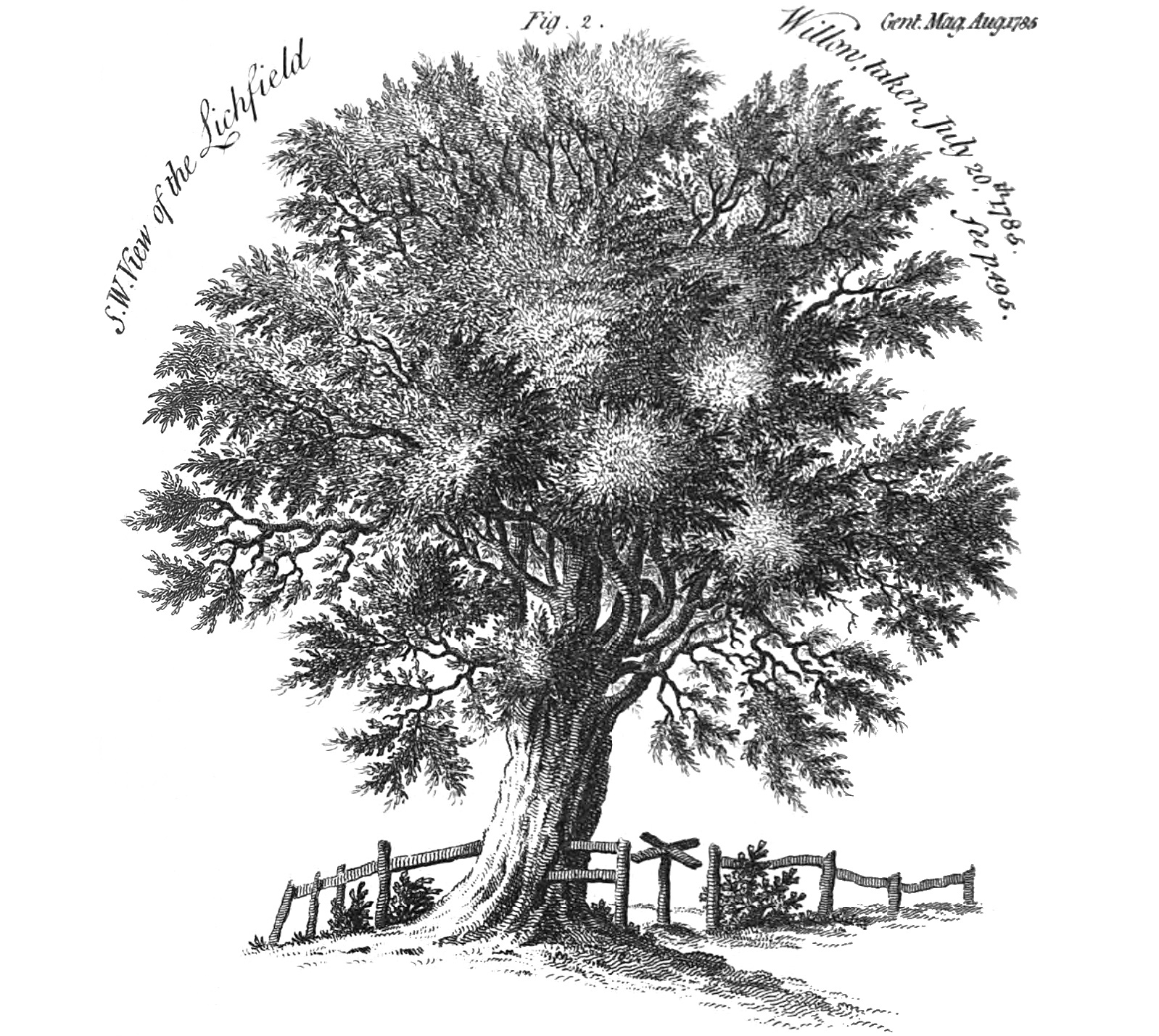
The Lichfield Willow (Johnson’s Willow) in July 1785
The Gentleman’s Magazine for July 1785 had carried an article by the Lichfield antiquary Richard Greene about Johnson’s interest in a huge willow tree growing in Lichfield (now known as ‘Johnson’s Willow’). Elizabeth was inspired by this to write her first Willow ode in praise of Johnson and the other distinguished figures associated with Georgian Lichfield – such as Garrick and Anna Seward – who might have walked or studied under the Willow’s boughs. To further boost the tree’s claim to fame, she created for it an ancestry stretching right back to the Tree of Knowledge in the Garden of Eden, and passing through the gardens of classical Greece and Rome before arriving in Lichfield. In this way, Elizabeth made the history of the Lichfield Willow a metaphor for the transmission of culture from ancient times to modern Britain – a theme she continued in her second Willow ode, in which she expressed the hope that a cutting from the Lichfield Willow would one day arrive in America to symbolise the onward migration of civilisation from the Old World to the New.
In the first Willow ode, the figure receiving by far the most attention is Johnson himself; Elizabeth’s tribute to him (and to his Willow) includes the following:
Sure Phoebus Son was Johnson namd
He various talents Shard!
Verse, Genius, Knowlege, Wisdom claimd
A Genuine Bard Declard!
His native Soil he oft Retrod,
which Reard this wondrous Tree;
With filial Love markd the abode
Of Both their Infancy.
Thus when in Future each is known
to Bloom with lengthd years
He like His kindred Willow Show
yet Vernal both appears!
Then Peace atend His Hallowd Shade
The Christian, Poet, Sage;
Who gave to Virtue evry aid
to Vice His keenest Page!
In a note to the last stanza quoted above, Elizabeth explains the warmth of her admiration for Johnson’s literary skills:
When we consider the various kinds of Composition that Dr Johnson excelld in, it is to be hopd this Eulogium will not appear too high Carrid; for the Hero of the Willow Groupe, His Dictionary, His Lives of the Poets, His Ramblers, His Poems, His Tragedies [sic], His Moral Alegorical Novel the Prince of Abyssina all excellent in their kind E F
Johnson also wins praise in the first Willow ode for his humanitarian acts, such as his rescue of a dying prostitute whom he found on Fleet Street, his (unsuccessful) interventions on behalf of the convicted fraudster Dr William Dodd, and his generosity towards his black servant, Francis Barber.
Elizabeth had hoped that her Willow odes would (like a number of her other compositions) appear in The Columbian Magazine; for some reason, however (possibly because of difficulties in deciphering her handwriting), this did not happen. Brief extracts were quoted in books and articles, but the full text of the odes remained in manuscript until the appearance of the first complete edition in 2020. Whatever their status as poetry, the Willow odes are of great interest from a variety of perspectives – and not least to admirers of Samuel Johnson, that ‘wonder of a Man’, as Elizabeth Graeme Fergusson described him.
Fergusson’s ‘Odes’ are available to purchase from the Birthplace Bookshop, or email sjmuseum@lichfield.gov.uk for details on how to place a postal order.