

Within the Birthplace Museum collection, one little book contains a particularly special inscription. At Easter in 1777, aged 68, Samuel Johnson took a moment of reflection and wrote down some resolutions for the months ahead in the back leaves of this volume.

Johnson gives his own account of the moment at which the inscription was made. He writes:
“I was for some time distressed, but at last obtained, I hope from the god of peace, more quiet than I have enjoyed for a long time. I had made no resolution, but as my heart grew lighter, my hopes revived, and my courage increased; and I wrote with my pencil in my common prayer book:
Via ordinanda
Biblia Leganda
Theologiae opera danda
Serviendum et laetandum”
The resolutions translate as: to order my life, to read the bible, to study theology, to serve god with gladness.
It was Johnson’s custom to observe religious holidays and personal anniversaries with what Boswell describes as ‘a pious abstraction’. In addition to Good Friday and Easter Day, the date of his wife’s death and his own Birthday provided moments for reflection. Johnson also made New Year’s resolutions, more on which can be read in this previous blog post. Another year Johnson had resolved: ‘to conquer Scruples, to read the bible this year, to try to rise more early, to study divinity, to live methodically, to oppose idleness, to frequent Divine worship.’
Johnson reflects on his habit of making resolutions in his own writings. In 1764, he describes in his ‘Prayers and Meditations’: “I have now spent fifty-five years in resolving; having, from the earliest time almost that I can remember, been forming schemes of a better life. I have done nothing. The need of doing, therefore, is pressing, since the time of doing is short. O God, grant me to resolve aright, and to keep my resolutions, for Jesus Christ’s sake amen”
In another passage written in 1770, Johnson reflects more generally on the making of resolutions: “every man naturally persuades himself that he can keep his resolutions… Those who do not make them are very few, but of their effect little is perceived; for scarcely any man persists in a course of life planned by choice…” Nevertheless, Johnson valued reflection and resolution-making as a form of self-improvement, encouraging his servant and heir Francis Barber to do the same.
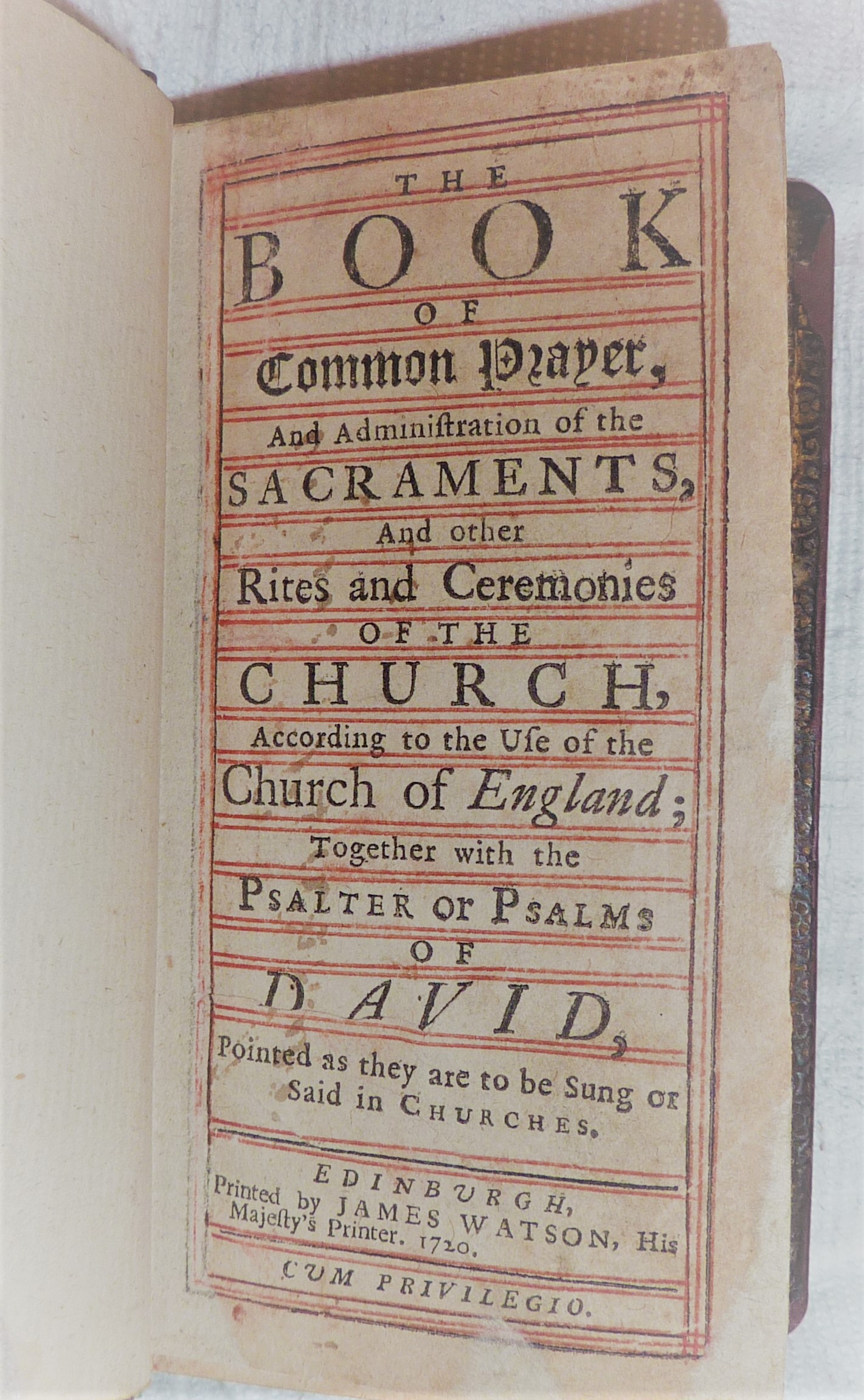
The book in which Johnson’s resolutions are scribbled is a 1720 edition of the Book of Common Prayer, published by James Watson. It is pocket-sized, with an ornate Moroccan binding, and worn, giving the impression that it was well-used and handled by Johnson. The book arrived at the Museum in 1909 as part of an exhibition of ‘Johnsonian relics’ to mark the Bicentenary of Johnson’s birth. It was the gift of Alderman Alfred Lomax, Lichfield printer and civic figure.
Johnson was introduced to the Book of Common Prayer as a small child, when his Mother obliged him to learn a portion. Throughout his life Johnson used the work as a basis for his own prayers. In June 1784 he told Boswell “I know of no prayers but those in the Book of Common Prayer”.

Sadly, Johnson’s inscription in the volume is now very feint, although he added the date in ink which can be clearly seen. It is fortunate that the contents were so well-documented by Johnson, and rare to have such a record of the story behind an inscription.