

This month’s blog post is written by Laura, Museum Attendant.
The Georgians loved playing games, especially at Christmas time. Games were something all ages and classes of people could play and were an excellent excuse to cause mischief! Some of their favourites are described below, but they also played charades, acted out parlour plays, sang, or played card games and forfeits. In 1829, a newspaper described the festivities at Appuldurcomb House, which included Christmas games: ‘Several of the old Christmas games formed the chief amusements of the juvenile members of the party assembled, who were all delighted with the novelty of the scene.’ [1] Perhaps you might consider playing the following games this Christmas, but we will leave Snapdragon to the Georgians!
Snapdragon
In 1818, a newspaper described the ideal Christmas ‘A good blazing fire . . . chestnuts . . . mince pies, Plum pudding [and] snap-dragon…’. [2] Snapdragon was a very popular Christmas game; it was a bit dangerous too! The players would place raisins into a bowl of brandy and then ignite the liquid. Those taking part would then pick out the raisins and eat them. As you can imagine, from time-to-time people got burned playing this risky game. There was even a remedy ‘To prevent burning the fingers [of] boys who delight in snap-dragon . . . pound cherry-tree gum and alum, in equal quantities, into powder, and mix the powder with strong wine vinegar, and leave it in a vessel over hot ashes to digest for twenty-four hours. Any thing rubbed with this composition, after it has become cold, will not burn.’ [3] Burning the fingers must have been a regular and embarrassing occurrence, because when a newspaper printed their predictions for the coming year, their December prophecy was that ‘Lord Broughham burns his fingers at snapdragon’![4]
Hunt the Slipper
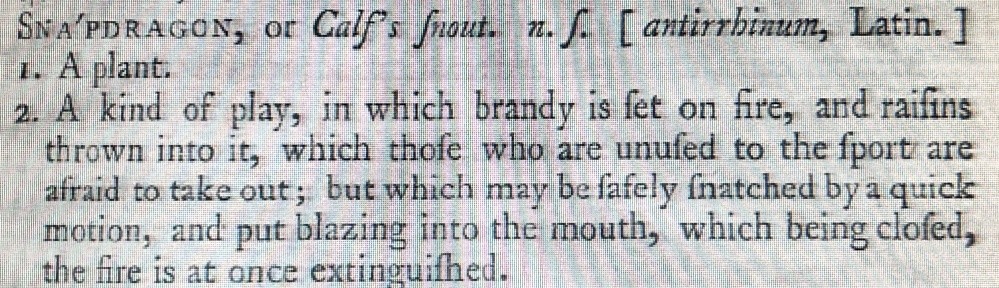
In the Sports and Pastimes of the People of England, the author tells us the instructions for Hunt the Slipper: the players ‘sit down upon the ground in a ring, with one of their companions standing on the outside; a slipper is then produced by those seated in the ring, and passed about from one to the other underneath their clothes as briskly as possible, so as to prevent the player without knowing where it is; when he can find it, and detain it, the person in whose possession it was, at the time, must change place with him, and the play recommences.’[5] Although a much safer game compared to snapdragon, one would hope the slipper being passed around the circle didn’t smell!
Bullet Pudding
Bullet pudding is mentioned in two letters written by Jane Austen’s niece, Fanny Austen in 1804, to a Miss Chapman. In her first letter she tells the recipient that her family had ‘. . . all spent a very merry Christmas . . . We had different amusements every evening. First we had Bullet Pudding, then Snap Dragon…’ When Miss Chapman replied and confessed that she didn’t know what Bullet Pudding was, Fanny responded: ‘I was surprised to hear that you did not know what Bullet Pudding is . . . you must have a large pewter dish filled with flour which you must pile up into a sort of pudding with a peek at top. You must then lay a bullet a top and everybody cuts a slice of it, and the person that is cutting it when it falls must poke about with their noses and chins till they find it and then take it out with their mouths . . . you must not use your hands in taking the Bullet out.’[6] This sounds like a fun, but very messy game. Imagine everyone covered in flour and laughing!
Blind Man’s Buff and Buffy with the Stick
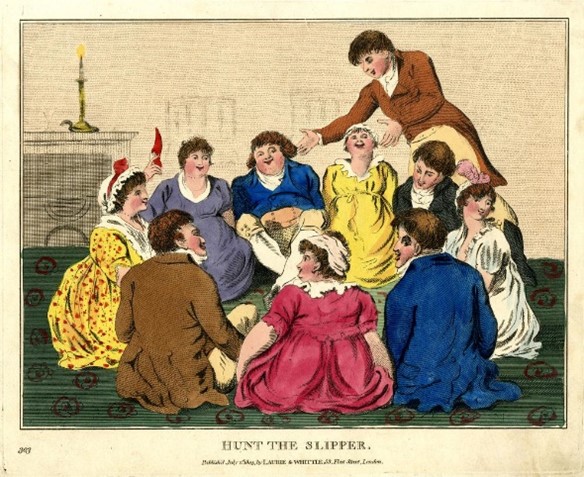
Blind man’s Buff was another popular game in Georgian England, and perhaps one we are all still familiar with today. Samuel Johnson described Blindman’s Buff in A Dictionary of the English Language as ‘A play in which some one is to have his eyes covered, and hunt out the rest of the company.’ In a book of Winter Evening Pastimes by Rachel Revel, Blind Man’s Buff is described as an ‘ancient pastime . . . [which was] probably, brought to England from France or Italy.’ There was another version of this game called Buffy with the Stick, which was more suited to ‘very large apartments . . . [or] in gardens.’ This involved the blindfolded player holding a stick or ‘long wand’, the rest of the party would ‘form a circle about him, and, joining hands, they dance to a tune . . . after once going round they stop. The player then extends the wand, and the person to whom it happens to be pointed must step out of the circle to hold the end of his hand. The player then interrogates by grunting three times . . . if he recognises the voice and names the party, without making any mistake, the party guessed pays a fine, takes the wand, and the game proceeds as before.’ [7]
Puss in the Corner
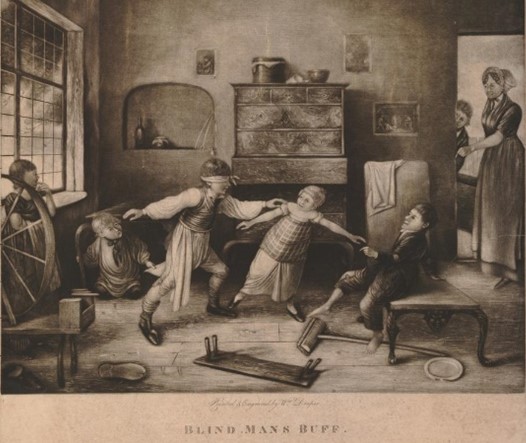
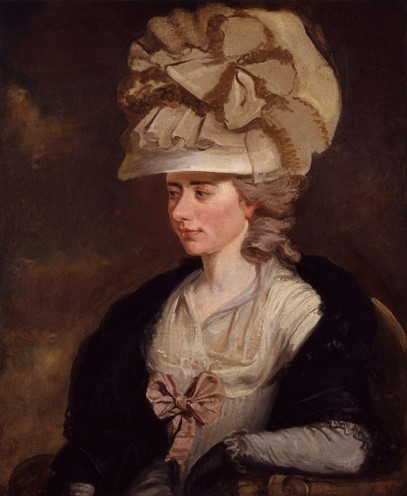
All you needed for this game was five people and a room. A book published in 1813, gives the following instructions for Puss in the Corner: ‘Four Boys or Girls post themselves at the four corners of a room, and a fifth in the middle [called Puss], who keeps himself upon the watch to slip into one of the corner places, whilst the present possessors are endeavouring to supplant one another.’[8] In an article for The Sporting Magazine, a game of ‘Puss in the Corner was proposed by Lord H——k, it being a game of which that nobleman is particularly fond. Although the proposition was opposed by some of the party, it appeared to meet the wishes of the majority, and accordingly the whole assemblage, with abundance of noise, commenced the gambol.’ [9] The article then goes on to give a lively commentary of the game. Frances Burney, the Diarist, novelist, and friend of Samuel Johnson, briefly mentions Puss in the Corner in her diary in 1785, whilst teaching a girl ‘some Christmas games…’
Resources:
[1] the Morning Advertiser – Tuesday 13 January 1829.
[2] the Drakard’s Stamford News – Thursday 24 December 1818
[3] the English Chronicle and Whitehall Evening Post – Tuesday 15 June, 1824.
[4] Age (London) – Sunday 05 October 1834
[5] The Sports and Pastimes of the People of England, by Joseph Strutt, 1830
[6] Jane Austen’s Christmas, compiled by Maria Hubert
[7] Winter Evening Pastimes; or, The Merry Maker’s Companion by Rachel Revel, 1825
Diary and Letters of Madame D’arblay, Vol. II. 1785 to 1788
[8] Observations or Popular Antiquities: Chiefly illustrating the origin of our vulgar customs, ceremonies and superstitions, by John Brand. 1813.
[9] The Sporting Magazine or monthly calendar of the transactions of The Turf, The Chase … Vol. 29. 1807. Article: The Late Christmas Gambols.
* All sources retain their original spellings and grammar.