

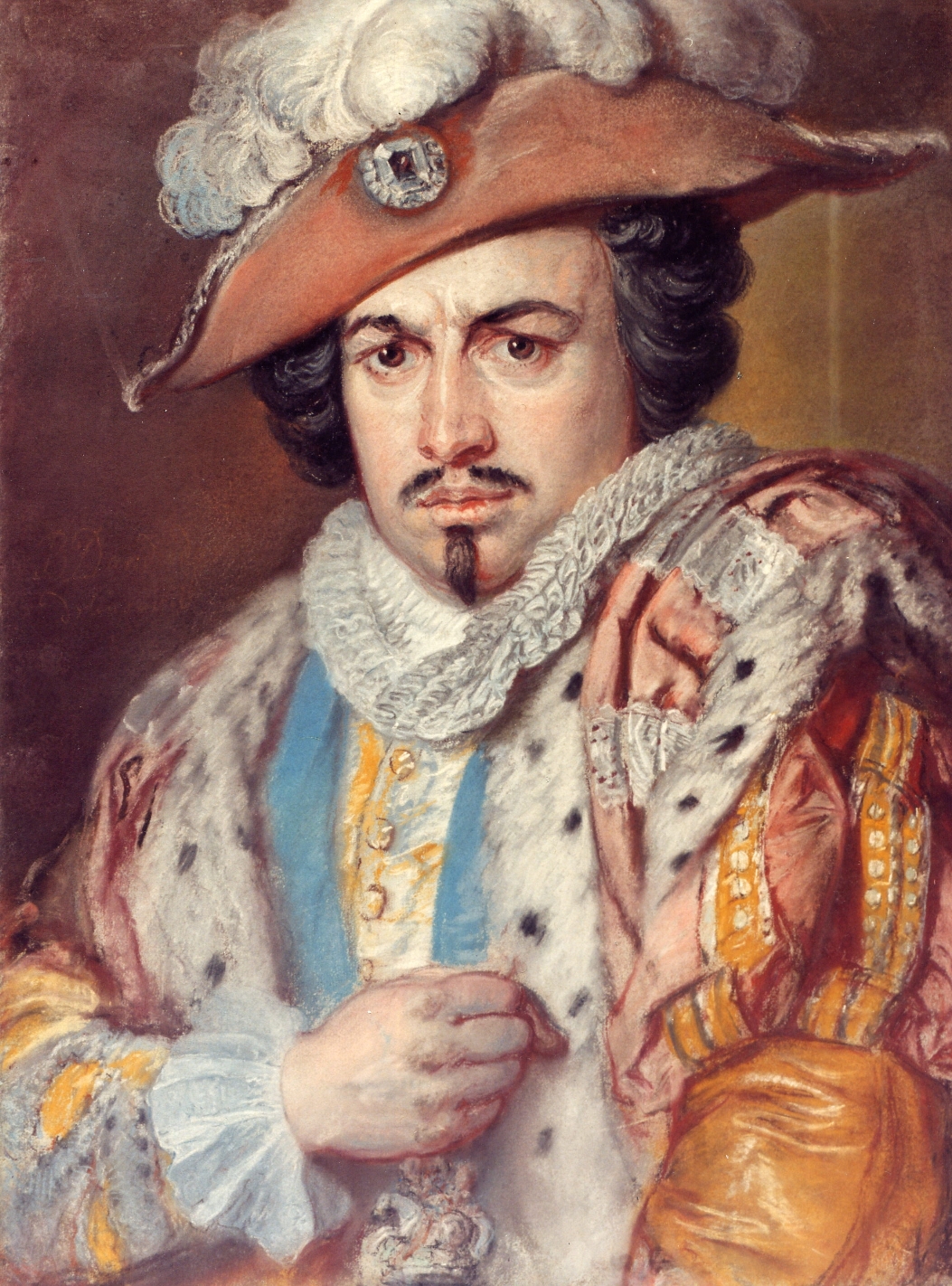
This beautiful pastel by Bartholomew Dandridge represents the famous 18th century actor David Garrick in his role as Richard III. It is the only known pastel portrait of the actor and it is the only known pastel produced by Dandridge. Today it seems as bright and fresh as on the day it was produced in 1750.
Pastel is powdered pigment mixed with a binder to produce a stick of colour. Sometimes these pictures were produced using several sheets of paper – piecing as it was called. This could mean a large portrait could be produced as big as any grand oil painting. Different features of the picture, the face for example could be produced at different times which might reduce the time a sitter had to be present. Maurice Quentin de La Tour’s portrait of a French magistrate is a wonderful example of this. However, this pastel of Garrick looks as though it were produced on one sheet.
During the 18th century pictures in pastel became very popular. More people wanted their portraits produced and pastel was cheaper than oil. It was also said that pastel was more luminous, the colours brighter. In fact, there was something of a rivalry between oil and pastel: Reynolds is said to have regarded pastel drawing as a past time for ladies.
There is nothing amateur about the picture that is presented to us here. King Richard from Richard III by Shakespeare fills the frame in his costly robes – not the costume of 15th century as the historical king would have worn, but the exuberant furs and ruffles of 18th century theatrical imagination. His costume certainly presents his power and dignity. It is however in the facial expression that Dandridge shows his skill in representing the characteristics of Garrick’s acting. His brow is furrowed, below his brown eyes, catching the light focus intensely. It is difficult to avoid their attention. The sharp nose and precisely manicured moustache and beard frame the passionate but firmly closed mouth. Dandridge completes this part of this intense composition by presenting the actor’s fist clenched in alignment below. The internal turmoil of the character is almost tangible – what anguish is the King grappling with? The picture is not linked to a specific scene, but the play concerns the King’s downfall and death so there is plenty of scope for the expression we see here.
It was this role, performed in 1741 that brought fame to Garrick. He was a novelty. He brought life and expression to his acting. Audiences had been used to the French method which was very stylized and where the actor’s every movement and gesture was controlled by a tradition of long-established codes. The lines were delivered in recitative. The whole effect would have been deeply dignified and sonorous and to a modern audience very odd. David Garrick’s use of realism in presenting his roles was an invigorating breath of fresh air. He soon proved that his skills were diverse and extended to every type of role, tragic and comic. And audiences loved him.
This pastel of Garrick in character as the King, is one of many, many pictures of him in role. In fact, apart from Royalty he is one of the most represented personalities of his time. Painters vied with one another to capture the delicacy of his various expressions. Below are a few examples of Garrick acting painted by some of the most famous painters of the day.
Garrick as Richard III by William Hogarth, 1745

From the Collection of Liverpool Museums

Garrick between Tragedy and Comedy by Joshua Reynolds, 1760- 1761

This image is an 18th century copy from the Birthplace collection, after the original painting by Joshua Reynolds now at Waddesdon Manor The topic of this painting was suggested to Reynolds by Garrick himself. It is a parody of the classical story in which Hercules chooses between Virtue and Pleasure. The correct choice is of course Virtue, but in this painting Tragedy (Virtue) and playful Comedy (Pleasure) seem joyfully equal to the lively and animated Garrick – the actor who could play all parts with such conviction
Garrick in ‘The Provok’d Wife’ by Johann Zoffany, 1763

From the Collection of Wolverhampton Museum & Art Gallery
Huge thanks to Annemarie Powell from the Birthplace volunteer team for this fascinating post. David Garrick as Richard III by Bartholomew Dandridge can be seen on display daily in the London Life room of the Samuel Johnson Birthplace Museum.