

This week Museum volunteer Annemarie Powell finds out more about the friendship of Samuel Johnson and Bennet Langton, inspired by a painting in the Museum collection, ‘Bennet Langton contemplating the bust of Johnson’ attributed to Johann Zoffany, c.1785
This unusual painting produced about a year after Johnson’s death, shows Johnson’s friend and admirer Bennet Langton gazing at the bust of the writer made by Joseph Nolleken 1777. It is a dark painting. Our eyes are drawn to the faces of the two men – the living and the sculptured and the papers that lie between them. We do not see the whole of the bust as it is set to the far right of the composition. Perhaps this gives the right feeling of pre-eminence to the massy head of the great thinker whose sculptured eyes seem to look on Bennet Langton, one assumes with affection. To the left, sits Langton. He leans forward, his head supported by an elegant hand, his face conveying a deep sense – as the title suggests – of contemplation. He has fine features, a faint tinge of warmth distinguishes him from the waxy colours of the bust. Langton’s eyes seem to gaze into the middle distance, perhaps his inner eye sees hi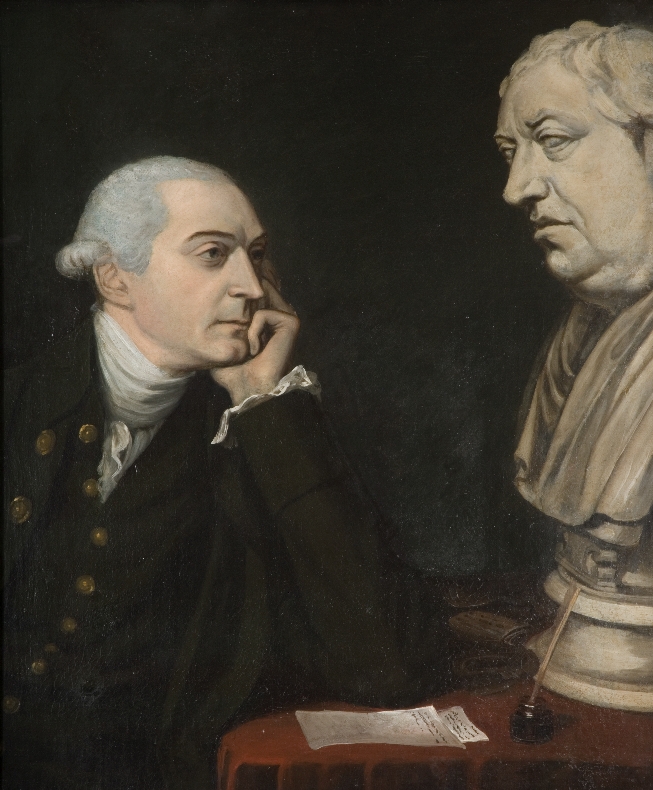 s time as Johnson’s friend again.
That friendship began when Langton was quite a young man, just before he went up to Oxford and Johnson was in his 40s. Full of admiration for Johnson’s ‘Rambler’, Bennet gained an introduction to the great man’s levee. Boswell gives us a lovely account of that first meeting. Langton of course expected to meet a decorous and neat philosopher; instead ‘down from his bedchamber, about noon, came, as newly risen, a huge uncouth figure, with a little dark wig that scarcely covered his head, and clothes hanging loose about him. But his conversation was so rich, so animated…… that he (Langton) conceived that veneration and attachment which he ever preserved.’
Indeed they remained good friends right up to Johnson’s death in 1784.
Over the years it seems as though Langton was a constant figure in Johnson’s life. We read of many dinners shared with friends in The Turk’s Head. Langton was a founder member of the Literary Club. Johnson delighted in giving nicknames to his friends: he was ‘Lanky’. Boswell was Bozzy and Oliver Goldsmith was Goldie, although Johnson was not too keen on such liberties being taken with his name. And through the many letters Bowell has preserved for us, we read of a friendship sometimes a little stressed, but always in the end warm and strong.
We hear of Langton and his friend Beauclerk waking Johnson at three in the morning to come walking in Covent Garden just as the fruit and vegetables are arriving from the country. In a letter written to Langton in May 1755 Johnson tells his friend that ‘I have published my book ( the dictionary) of which I beg to know your father’s judgement, and yours;’ He has been invited to visit Langton at his home in Lincolnshire, but he cannot come ‘I will give the true reason, which I know you will approve:- I have a mother more than 80 years old who has counted the days to the publication of my book, in the hopes of seeing me…’
Some letters apologise for late answering, others wonder why there has been a gap in their communication. Johnson offers his friend support and advice, sends him his new published works, but the letters are not all academic and intellectual, there is much that speaks of the domestic interests of everyday life. ‘I have left off housekeeping and therefore have made presents of the game you were pleased to send me. The pheasant I gave to Mr Richardson (the author of Clarissa) ….and the pot I placed with Miss Williams, to be eaten by myself..’
This was a true, well rounded friendship. ‘How welcome … your invitation to your new house was to me, I need not tell you, who consider our friendship not only formed by choice, but matured by time.’ (9 June 1781)
As Johnson reaches the end of his life, he is ill and depressed. ‘I wish we lived nearer and rejoice in your removal to London..’. Langton does not desert him. Boswell writes that ‘Nobody was more attentive to him than Mr Langton’.
And so finally at Johnson’s funeral in Westminster Abbey Langton performed his last act of friendship as one of the six pall bearers who carried Johnson’s coffin to its final resting place.
So Langton has a great many years as Johnson’s friend to think of as he gazes at his bust in this painting. The bust we see by Joseph Nollekens was the only sculpture produced of Johnson in his lifetime. Nollekens was another of Johnson’s friends – Nolly. Perhaps it is no surprise therefore that this sculpture was considered by many to be the best work Nollekens had produced when it was exhibited at the Royal Academy in 1777. But not everyone admired it. Nollekens had intended to represent Johnson as an ancient poet with flowing hair and a natural attitude. It would seem this did not meet with the approval of the ladies Thrale, Reynolds and Garrick. Perhaps they would have preferred a different more dignified classical model: a noble profile, short hair and laurel leaves about the head!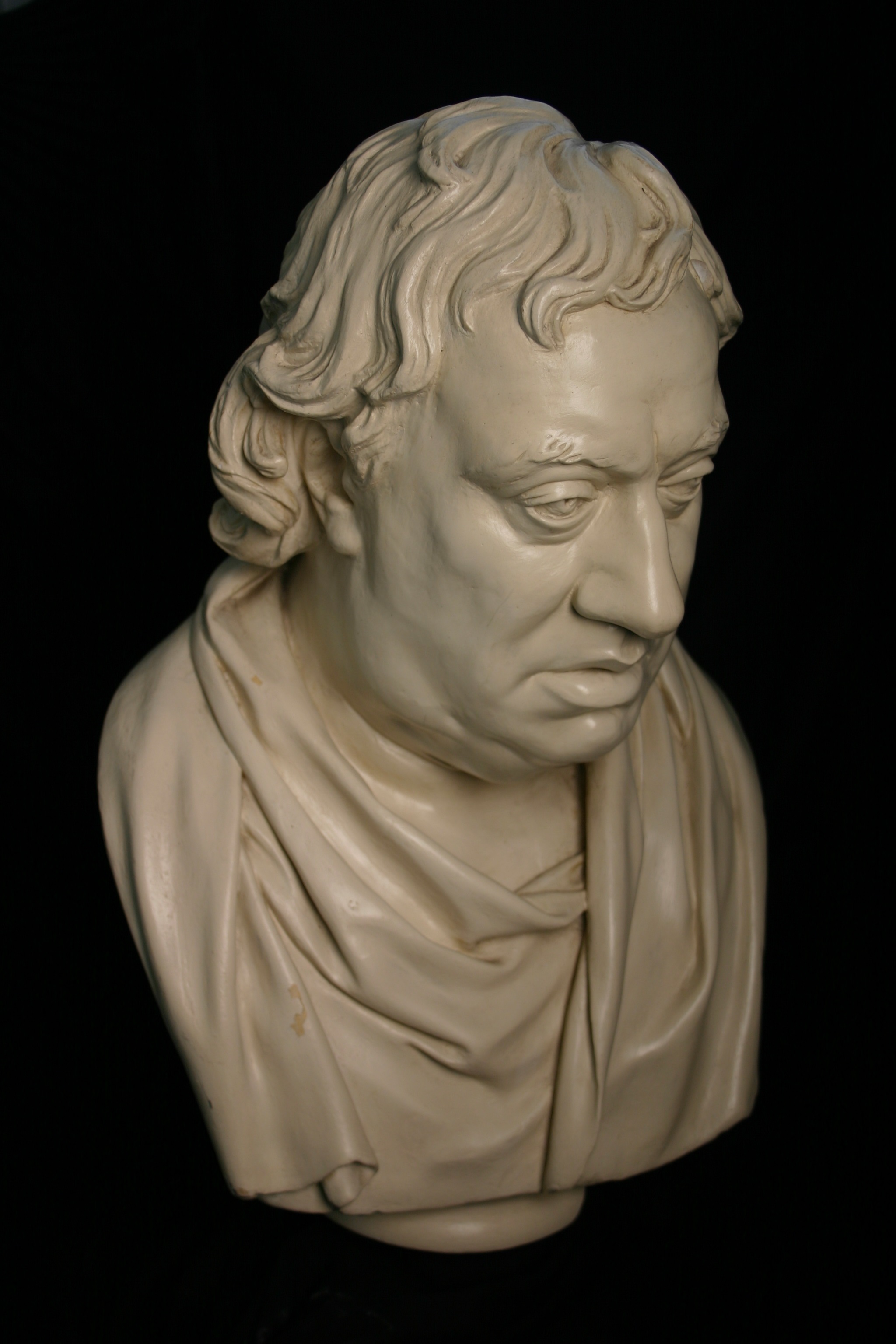
‘Bennet Langton Contemplating the bust of Samuel Johnson’ is just one of many paintings which we’ll be highlighting in our Paintings in Focus exhibition from Saturday 13 July – Sunday 8 September. Visit our events page to find out more.