
 If you have been paying attention to the Birthplace website, you may have seen a few changes recently, with the introduction of a new section called Visiting for Research, as well as links to our brand new YouTube channel with two video guides for researchers.
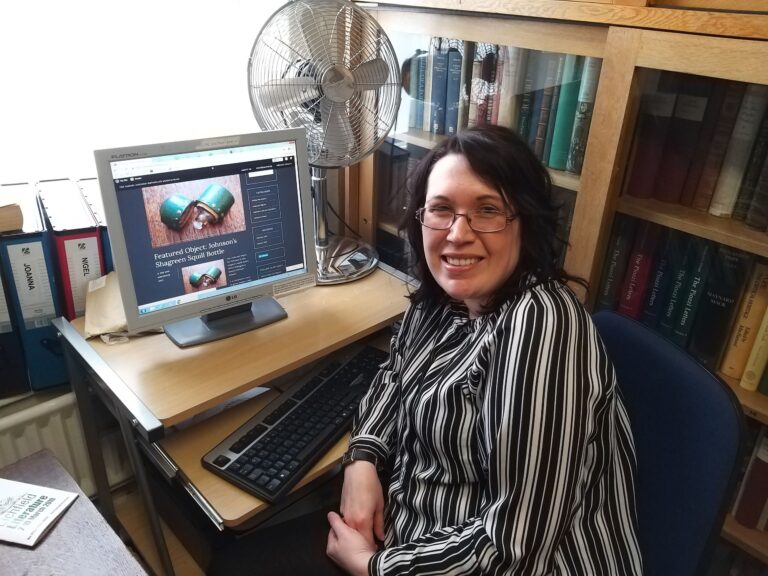
Both this blog and the new section of the website have been the work of visiting Keele University MA student Amy Louise Blaney, who recently completed a work placement with us. In today’s post, Amy shares her work with the museum and explains the aims of her project.
As a (*ahem*) ‘mature’ postgraduate student who has been in the workplace for 11 years, I was keen not to lose any skills when I went back to university full-time. It can be easy for academia to become a little disconnected from the ‘real’ world but I’ve always wanted to find ways to make my research interests approachable. So when the chance to conduct a placement that combined my research of eighteenth-century literature with an opportunity to learn new skills and help widen access to an archive of important eighteenth-century materials came along, I jumped at the chance!
My supervisor at Keele, Dr Nicholas Seager, had been working with the Birthplace on an Eighteenth Century Textual Studies programme so he was able to put me in contact with Jo Wilson. Working with Jo, I designed a placement plan that focused on widening access to the Birthplace Museum’s extensive collection of over 8,000 items relating to Johnson, his circle and eighteenth-century Lichfield.
Jo and I were both keen to produce materials that would widen engagement between the museum and researchers who wished to access the collection, as well as to increase the museum’s engagement with their varied and international audience of both scholars and visitors.
 Having established and run my own book blog, I suggested that a blog might be a way of reflecting the varied activities that the Birthplace Museum is involved in. As both an international research library for Johnson scholarship and an accredited museum, the Birthplace has lot of different visitors and I felt that a blog would allow them to run posts by visiting researchers alongside behind the scenes contributions from staff and volunteers, and news items about upcoming or past events.
Establishing this blog has been great fun and I’ve been thrilled by the engagement that we’ve had, with posts by local school and sixth-form students sitting alongside contributions from authors, museum volunteers and eighteenth-century scholars. Although my own involvement has now come to an end, I very much look forward to reading future posts and seeing the blog grow and develop.
The second half of my placement was more challenging, as I wanted to create a set of resources that would both encourage and support visiting researchers, especially higher education students who may never have visited an archive or museum before. This part of the project was particularly important to me because, as an 18 year old undergraduate student, I had been put off visiting a research library by the seemingly incomprehensible rules surrounding reader’s tickets, gloves, bags, and the use of pens!
Jo and I both agreed that, although there have to be ground rules in place to protect the collection, visiting an archive or museum shouldn’t be daunting. Whether you’re researching family or local history, or conducting academic research, archives and museums can offer quiet, comfortable and beautiful surroundings in which to carry out your research.
 I was keen to try audio and visual material as a way of providing guidance on what to expect when visiting the Birthplace. After researching video materials posted online by other museums, I agreed a script and storyboard for two videos with Jo. The first would provide a general introduction to the museum for new researchers, showing the space available and providing directions and information about the facilities on offer, whilst the second would be a more general video that dealt with handling old books, running through some common ‘rules’ and showing new researchers how to use archive materials such as book rests, weighted book snakes, and acid-free tissue slips.
Having borrowed a camera kit from Keele and given the Wood Library a thorough spring clean, the videos were recorded and I got to work editing, incorporating slides and images, and adding my pre-recorded audio over the top. Having never produced or edited a video before, I am pleasantly surprised by the results, which can now be viewed over on the Birthplace’s new YouTube channel.
I have thoroughly enjoyed my placement at the Samuel Johnson Birthplace Museum and have been privileged to work alongside a wonderful team of staff and volunteers who have been welcoming, helpful and enthusiastic. Developing the blog and visitor materials has given me new insight into ways in which the educational work of universities and that of museums overlaps, and I hope to develop further opportunities to collaborate with museums and archives as my studies progress.
Contributor: Amy Louise Blaney is an MA English Literatures student at Keele University. Her current research examines the impact of Arthurian Literature upon masculinity across the late eighteenth and early nineteenth centuries. Amy has recently been awarded a North West Consortium Doctoral Training Partnership studentship, allowing her to continue her research into eighteenth-century Arthurianism. She will commence her PhD studies at Keele in September 2019.